
One of my favorite parts of working with small business owners is hearing the origin story—how they started, the early risks they took, the long nights, the first hire, and the employee who’s been there “since day one” and still feels like family. There’s pride in those stories, and there should be. Small businesses don’t survive by accident. They survive because someone cared enough to build something and keep it alive when quitting would have been easier.
But there’s a phrase I hear in those same conversations that almost always stops me in my tracks: “We’ve always done it this way.”
It’s rarely said defensively. More often, it’s said casually and matter-of-fact, almost comforting, like a familiar chair you’ve been sitting in for years. The problem is that comfort can quietly turn into cost.
What Is Status Quo Bias in Business?
Status quo bias is the tendency to prefer current processes and practices simply because they’re familiar, even when better alternatives exist. In small businesses, status quo bias typically shows up in hiring processes, employee onboarding, performance management, and compensation structures—areas where “the way we’ve always done it” can quietly cost thousands of dollars each year in lost productivity, turnover, and missed opportunities.
When Familiar Processes Become Hidden Barriers
Not long ago, I was meeting with a business owner who was frustrated they couldn’t find good people. Turnover wasn’t terrible. Pay was competitive. Culture was solid. Customers were happy. But hiring felt broken.
“We just aren’t getting applicants anymore,” they told me. “Nobody wants to work.”
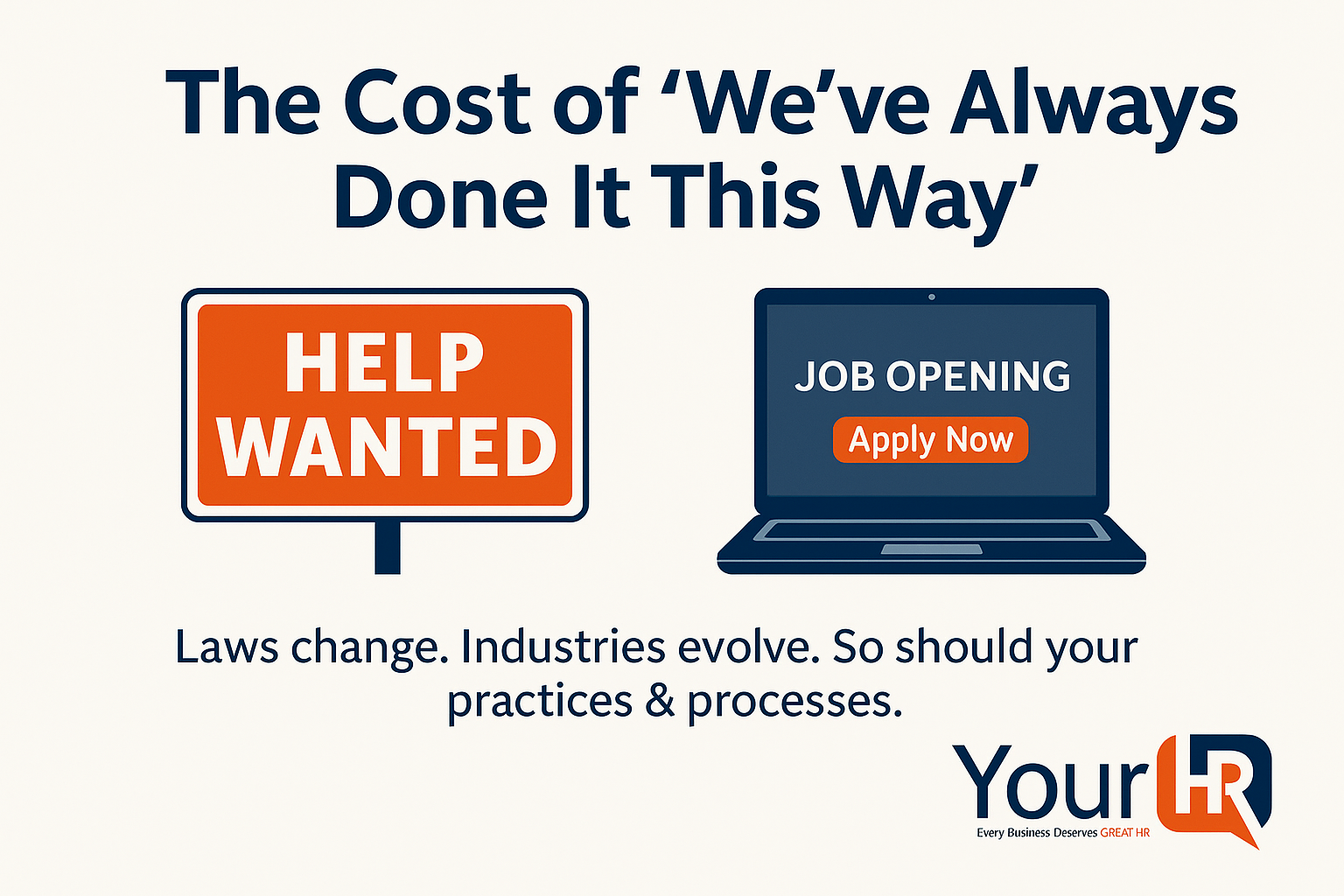
As we walked through their hiring process step by step, nothing jumped out as outrageous—until we got to the application. They required applicants to come into the office, during business hours, and fill out a paper application at the front desk. When I asked why, the answer was immediate: “That’s how we’ve always done it.”
Here’s the reality: More than 70 percent of job seekers now complete applications using a mobile device, according to SHRM. They’re applying during lunch breaks, from their car between errands, or after the kids go to bed. Requiring an in-person paper application during business hours isn’t a neutral choice anymore—it’s a barrier that filters out qualified candidates before you ever see their resume.
This business wasn’t losing candidates because of pay or culture. They were losing them at the very first step.
Once we moved the process online, simplified the application, and tightened communication with applicants, qualified candidates started flowing in again within days. Same company. Same pay. Same culture. Different outcome.
The Hidden Costs of Outdated HR Practices
When business owners think about cost, they usually think in obvious terms: wages, benefits, overtime, turnover. But the most expensive costs in HR are often invisible.
The hidden costs of outdated HR practices include: extended time-to-fill that drains team productivity, employee burnout from covering vacant roles, delayed growth opportunities, compliance risks from outdated policies, and turnover driven by poor manager development. These costs don’t show up on a single line item—they’re spread across overtime, missed revenue, and the slow erosion of your best employees’ engagement.
Time-to-fill—the number of days between posting a job and a candidate accepting an offer—continues to rise across industries according to the U.S. Bureau of Labor Statistics. Every extra day a position stays open quietly drains productivity and momentum. For small businesses operating with lean teams, even one unfilled role can force strong employees to carry extra weight while managers stretch thin and burn out.
Honoring the Past Without Being Held Hostage by It
This isn’t an argument against tradition. Some of the healthiest companies I work with are successful precisely because they value consistency and loyalty. The issue isn’t honoring what worked before—it’s assuming what worked before still works now.
A quote often attributed to Peter Drucker captures this perfectly: “The greatest danger in times of turbulence is not the turbulence; it is to act with yesterday’s logic.”
That yesterday’s logic shows up everywhere in small business HR: outdated pay structures that no longer match market rates, annual performance reviews that provide feedback too infrequently to drive improvement, manager promotions based on tenure rather than leadership ability, and policies copied from a template years ago and never revisited for compliance or relevance.
Where Small Business HR Systems Fall Behind
Many HR systems lag behind how people actually work today. Some owners rigidly track time for salaried roles that are really about outcomes, while others avoid time tracking for hourly roles that legally require it under the Fair Labor Standards Act.
Employee onboarding is another common gap. Effective onboarding is a structured process that helps new employees understand their role, learn company systems, and integrate into the team within their first 90 days. Many small businesses still rely on a sink-or-swim approach—hand someone a stack of paperwork on day one and hope they figure it out. This approach worked when labor markets were different, but now leads to confusion, early exits, and wasted recruiting investment.
Gallup reports that nearly half of employees say they are unclear about what is expected of them at work. That’s not a motivational problem—it’s a systems problem. When role clarity is missing, even your best hires underperform.
Why Business Owners Resist Changing HR Processes
There’s an emotional side to “we’ve always done it this way,” especially for founders. Changing a process can feel like admitting the old way was wrong or that the business they built needs fixing.
In reality, growth doesn’t erase what was built—it builds on it. The hiring process that worked when you had five employees isn’t wrong; it’s just not designed for a company with twenty-five employees. The performance conversations that happened naturally in a small team need structure when managers are overseeing multiple direct reports.
Some of the strongest leaders I work with regularly ask two questions: “If we were starting this company today, would we do it this way?” and “Is this serving the business we have now, not the one we had ten years ago?” These questions separate leaders who grow from those who get stuck.
The Real Cost of Staying the Same
One of the biggest myths in small business HR is that change is expensive. Sometimes it is. More often, the cost of staying the same is higher.
Here’s what outdated HR practices actually cost: Outdated hiring processes cost you candidates who never apply. Unclear roles and expectations cost productivity every single day. Misaligned pay structures increase compliance risk and drive quiet quitting. Weak manager development quietly pushes your best people out the door to competitors who invest in leadership.
The businesses that last aren’t the ones chasing every HR trend—they’re the ones willing to pause, reassess, and adjust when their processes no longer match their reality.
How to Identify Outdated HR Practices in Your Business
Instead of asking “Why change?” a better question is “What is this costing us right now?”
Start by auditing your current processes with these questions: How long does it take to fill an open position, and has that number increased? Can candidates apply for jobs from their phone in under five minutes? Do new hires have a structured onboarding plan for their first 90 days? When did you last review your pay structure against current market rates? Are your managers trained to have effective performance conversations, or are they winging it?
The cost of “always” is subtle. It hides in missed applicants, disengaged employees, and overwhelmed managers. The good news is that meaningful improvement often comes from small, intentional changes. You don’t have to overhaul everything overnight.
Ready to find out what your current HR practices are actually costing you? Schedule a free HR process audit with YourHR. We’ll walk through your hiring, onboarding, and management systems together and identify the gaps that are quietly draining your time, money, and best people.


