
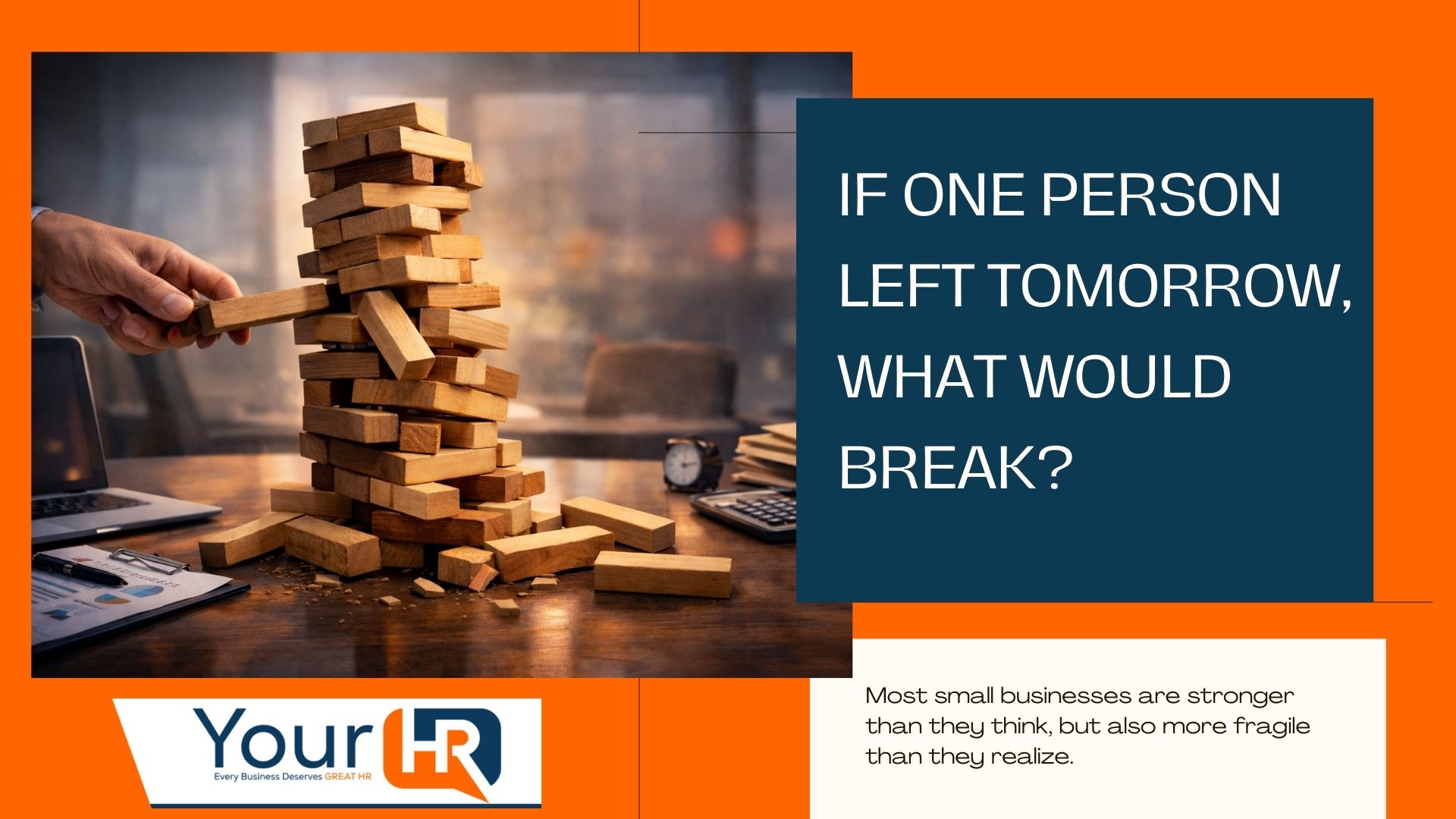
I was in a leadership meeting recently when someone asked a question that stuck with me: “If she left tomorrow, what would we do?”
The room got quiet. It wasn’t about performance or loyalty. It was about fragility.
What Is Organizational Fragility?
Organizational fragility is the degree to which a business depends on specific individuals, undocumented processes, or informal systems to function. A fragile organization can operate smoothly day-to-day, but lacks the resilience to absorb disruption—whether that’s an unexpected resignation, an extended illness, a compliance audit, or a sudden market shift.
In small and mid-sized businesses, we build around people. That’s often why the business works. You hire someone capable, give them more responsibility, and over time they become the center of gravity for an entire function. Then one day you realize something uncomfortable: if that person gets sick, retires, resigns, or burns out, you don’t just have a staffing issue. You have a business risk.
How Does Organizational Fragility Develop?
I see this pattern often in founder-led companies. Payroll sits with one long-tenured office manager. Vendor relationships live in the head of one operations leader. Recruiting depends entirely on one person’s network. Compliance documents are saved on one laptop. The knowledge is real. The commitment is real. The exposure is also real.
Organizational fragility rarely develops intentionally. Growth pulls attention forward. Urgency wins over structure. You get busy serving customers and solving today’s problems. Examining fragility feels like a luxury—until it isn’t.
The U.S. Bureau of Labor Statistics reports median employee tenure in the United States at just over four years, and closer to three years for employees aged 25 to 34. Turnover is normal. Yet many small businesses operate as if key people will stay indefinitely.
What Are Single Points of Failure in a Business?
A single point of failure is any person, process, or system that, if removed or disrupted, would cause a critical business function to stop or fail. In small businesses, single points of failure are often people—employees who hold essential knowledge, relationships, or access that no one else shares.
Common single points of failure in small businesses include: one person who knows how to run payroll, one person with admin access to the HRIS or benefits portal, one person who manages all vendor relationships, one salesperson whose customer relationships live on their personal phone, one employee who handles compliance documentation, and one manager who holds all institutional knowledge about how things actually work.
Identifying single points of failure isn’t about distrust. It’s about design. The question isn’t whether your key people are reliable—it’s whether your systems can function without any single individual.
What Is Operational Succession Planning?
Operational succession planning is the process of ensuring that critical business functions can continue if the person currently responsible leaves, even temporarily. Unlike executive succession planning—which focuses on leadership titles and organizational hierarchy—operational succession planning focuses on functions: payroll, compliance, customer relationships, vendor management, and core processes.
Small businesses need operational succession planning just as much as executive succession planning. The question isn’t “who will be the next CEO?” It’s “who can step in, even temporarily, if something changes?”
What Is Compliance Stress Testing?
Compliance stress testing is the practice of evaluating whether your organization could respond effectively to a regulatory audit, employee complaint, or legal challenge. It asks: if pressure arrived tomorrow, where would we struggle?
Compliance obligations continue to increase at both federal and state levels—wage and hour rules, minimum wage changes, paid leave requirements, pay transparency laws. When one person holds all that knowledge without backup, the risk isn’t just operational. It’s financial.
To stress test your compliance, ask: If the Department of Labor knocked on your door tomorrow, could you confidently produce time records, job descriptions, and pay history? If a harassment complaint surfaced, do you have documentation of training and a clear investigation process? If an employee filed a wage claim, could you demonstrate proper classification and overtime tracking?
The average cost of defending an employment claim can easily reach tens of thousands of dollars before settlement. For a small business, that’s real disruption. Stress testing doesn’t assume the worst—it identifies where you would struggle under pressure so you can address gaps before they become crises.
How Do You Build Organizational Flexibility?
The past few years have shown how quickly circumstances can shift. The businesses that navigated those shifts best weren’t necessarily the largest. They were the ones that could pivot without unraveling.
Organizational flexibility comes from three things: clarity, documentation, and cross-training. When roles are clearly defined, work can be redistributed. When processes are documented, someone else can follow them. When cross-training is intentional, you’ve built a buffer against disruption.
I worked with a client who had one person handling both accounts payable and payroll. They decided to cross-train another employee simply to cover vacations. Six months later, the original employee faced a family emergency and needed extended time off. It was stressful, but it didn’t cripple the business. Buffers aren’t built in crisis. They’re built before it.
How Do You Assess Organizational Fragility?
For small business owners, assessing organizational fragility starts with three questions. Don’t answer quickly. Let the room sit with them. The discomfort is useful.
First: If one key person left tomorrow, where would we feel it first? This reveals your single points of failure—the functions that depend entirely on one individual’s knowledge, relationships, or access.
Second: If we were audited or faced a formal complaint, where would we scramble? This reveals your compliance gaps—the documentation, training records, or policies that exist informally or not at all.
Third: If revenue dipped by ten percent, where would we struggle to adjust? This reveals your operational rigidity—the areas where you lack the flexibility to scale down or redistribute work.
Why Does Reducing Organizational Fragility Matter?
For HR professionals, part of our role is surfacing these risks without sounding alarmist. We’re not predicting disaster. We’re designing systems that make disruption less damaging.
Growth amplifies whatever foundation you have. If systems are loose, growth exposes it. If compliance is informal, growth tests it. If culture depends on one personality, growth strains it.
Examining fragility isn’t pessimistic. It’s responsible leadership. It also creates freedom. When knowledge is shared, owners can step away without fear. When processes are documented, onboarding is faster. When cross-training is normal, employees gain broader experience. When compliance is organized, conversations shift from reactive to proactive.
How Do You Reduce Organizational Fragility?
Reducing organizational fragility doesn’t require building bureaucracy. It requires thoughtful structure. Start with these steps: Document core processes in simple language that anyone can follow. Identify at least one backup person for every critical function. Review job descriptions to ensure they reflect actual duties. Schedule an annual compliance checkup to identify gaps before auditors do. Build cross-training into employee development plans as a standard practice, not an emergency response.
Every business has some fragility. The goal isn’t perfection—it’s awareness. When I sit with owners who have been through disruption, they rarely say they were blindsided. More often, they admit they knew where they were exposed. The better question isn’t whether something will change. It’s whether your organization can absorb change without breaking.
Not sure where your organization is most fragile? Schedule a free organizational risk assessment with YourHR. We’ll help you identify single points of failure, stress test your compliance, and build the systems that let your business absorb change without breaking.
Sometimes it starts with a quiet question in a conference room: “If she left tomorrow, what would we do?”


